MIL-188-110A-MOD is a modified version of the popular MIL-188-110A mode.
|
Parameter |
Value |
|
Frequency range |
HF |
|
Operation modes |
Unprotected |
|
Modulation |
8-PSK |
|
Symbol rate |
2400 Bd |
|
Center frequency |
1800 Hz |
|
Receiver settings |
LSB or USB |
|
Input format(s) |
AF, IF |
Like MIL-188-110A, this mode employs 8-ary phase shift keying (PSK) on a single carrier frequency (1800 Hz) as the modulation technique for data transmission. The carrier modulation is a constant 2400 Baud waveform.
Each transmission of a MIL-188-110A-MOD message begins with a 267 ms long synchronization phase (preamble) followed by the data phase, which is of unlimited length. The data phase is structured in User Data (20 unknown 8-PSK symbols) – Channel Probe (20 known 8-PSK symbols) pairs.
The MIL-188-110A-MOD decoder demodulates the waveform and displays the raw demodulated output in HEX format.
Tuning the Decoder
The decoder processes signals in both SSB settings: USB and LSB. This can be selected with Polarity in the menu: NOR means USB and INV means SSB.
The center frequency of the decoder should be set to 1800 Hz when the receiver is correctly tuned to the transmitting station. Small frequency variations are automatically compensated in the decoder. The frequency of the decoder can be adjusted to ±400 Hz from its normal settings. By using the bar-graph, any remaining frequency difference can be compensated by fine tuning of the receiver frequency or by adjusting the center frequency of the decoder.
Dedicated Phase Plane
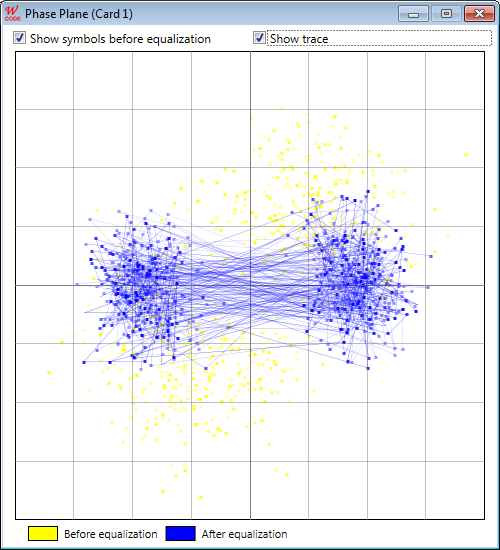
The decoder uses an equalizer to demodulate the high-speed PSK signal. To visualize the power of the equalizer, the user can turn on the dedicated phase plane in Options -> Show Phase Plane. The points in yellow refer to data symbols before equalization, whereas the blue points refer to data symbols after equalization.
MIL-188-110A-MOD Phase Plane.